
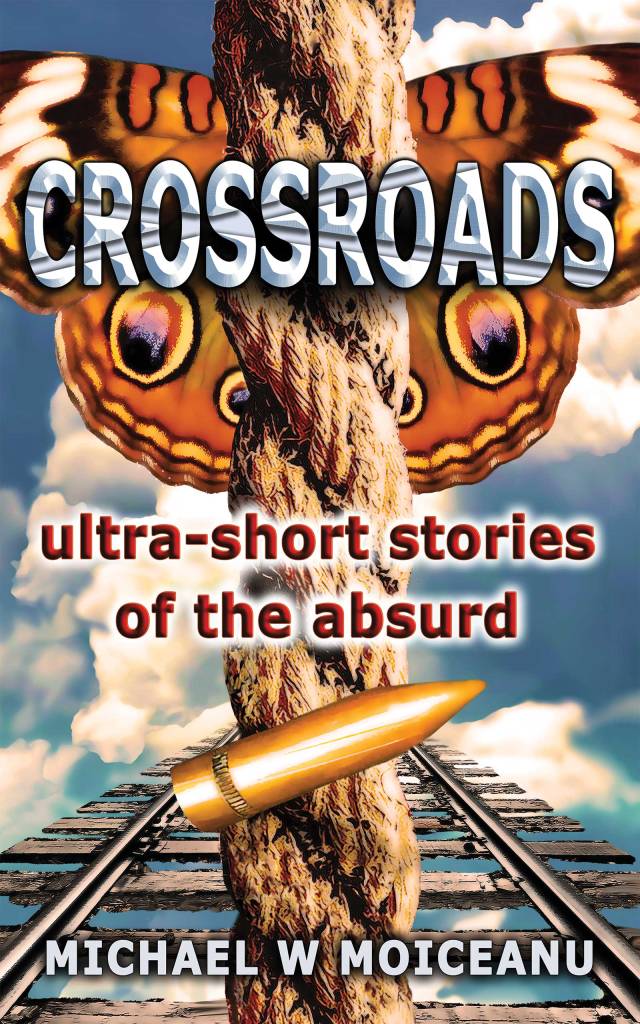
Originally published in 2017, updates to the collection’s cover, design, layout, as well as minor embellishments to a few grammatical expressions and related corrections, were completed by me, its author, in February 2026. Having a five-star review as of today, the collection has recently been relaunched in its revised format on Amazon in both Kindle and Paperback formats.
Book Description:
Ranging from under 2000 words to a little over 100, the eighteen Kafkaesque flash-fictions of this collection collectively explore themes of perception, conflict, societal flaws, existential quandaries, and the human condition through a prevailing tone of absurdity. Making frequent use of metaphor, irony, magical realism, philosophical enquiry, and surreal imagery, these richly varied, allegorical, and sometimes biting narratives are best slowly savored, this as they challenge and provoke thoughts regarding issues that span the contemporary to the timeless.
The topics addressed in this tapestry of at times dark-humored, sometimes touching, occasionally disquieting, and often Twilight-Zone-ish stories include: the culmination of climbing ropes suspended from skies, the troubles associated with having a detachable heart, political revolutions that end up resulting in the same, a society which views compassion for the other as a disease, interactions between free-willed puppets, a town’s triumphant fix for the butterfly effect, the implications of a scientifically verified method for making dogs insane, the attempts to substitute a prospective war with a fully civilized game of wits, and the logically valid impossibility of anyone anywhere ever obtaining a first kiss.
Excerpts:
Following are the first two complete stories from the collection, followed by a preview of four others:
Please click –here– if you would like to read the two excerpts directly through Amazon’s sample preview, which will show the formatting found in both the ebook and paperback along with the Table of Contents.
There once was a small town on the outskirts of society that was troubled by tornadoes. The tornadoes caused tremendous damage to property. Additionally, some of the fellow townsfolk got injured and died due to their occurrence.
With the tornadoes being a big problem, one day one citizen of the town—one highly admired by others for his intellect—came upon an article regarding chaos theory. The reading divulged that a butterfly’s flapping of the wings at one place in the world could result in an entire tornado brewing at a different location on the planet.
Meetings were called where this revelation of the butterfly effect was disclosed to all. Soon enough, the town began converging on a general agreement: the thing to do was to eradicate the planet of all its butterflies.
“Damn them,” townsmen would exclaim as they’d spit onto the floor. Most everyone was pleased with this remedy to put a permanent end to the town’s tornadoes; most everyone, that is, but for the village idiot.
“I know I know nothing and, maybe, not even that much—but, then again, I could be wrong,” like a clown the village idiot would assert; this and so many other ridiculous notions that people didn’t know whether to laugh or cry at his states of mind. Regardless, the village idiot every now and then yet tried to communicate his ludicrous thoughts to others.
On this occasion, he could be seen scratching his head as he stood behind the town hall crowd.
He raised his hand and then his voice: “You’re all mad,” he exclaimed, “There’s so many other ways of interpreting this here mathematical theory. Why, here, I’ve just stomped my foot on the ground. Does that then mean I’m responsible for a vibration that could avalanche into a future earthquake? What about my waving of a hand being the cause of some future hurricane? So why then think that butterflies bear the blame for our tornado problem?”
“What morsel of wit do you possess, man? Your foot-stomps and hand-wavings have absolutely nothing to do with the flights of butterflies, which in fact do cause tornados,” proudly responded the speaker of the town hall meeting, the crowd riotously laughing at the village idiot’s lunacy.
The village idiot, though trying to continue in his speech, was shortly thereafter dragged out of the hall. There, he continued screaming things such as, “You’ll destroy the planet’s ecosystems in your attempts to eradicate all butterflies!” “Our crops will be slowly depleted without butterflies’ pollination!” and “Others will condemn us for poisoning their lands—wars with follow!”
The doors to the hall were quickly closed.
People, some more than others, began to murmur between themselves: “He’s a traitor, a damn terrorist for trying to prevent us from preserving our homeland,” “He should be locked away; what good has he ever done for society anyway?” “To hell with that, he ought to be killed.” This as the fool continued banging on the town hall door while still screaming his now inaudible sermons.
It was concluded. The manufacturing of toxins was to be ordered for the poisoning of all butterflies in the world. No matter the stupidities which the idiotic fool uttered, the intelligence of so doing was entirely ingenious and, indeed, wise. Besides, the new business that would soon bolster the town’s economy made the citizens merrier and all the more determined.
In a few months’ time, the war on butterflies had commenced. “Until the life of every last butterfly is axed; until all children inherit tornado-free lands!” was the motto many fervidly chanted. Among other declarations given by statesmen and voters alike, these slogans were making the town unified as it never before was.
Everyone was in high spirits, and blissfully mirthful. Even the village idiot—after some secret ordeals of prolonged, intense torture—ended up delightfully confessing to all in town that his previously given statements concerning the matter had all been half-baked and thoroughly absurd.
Cohorts became steadily dispatched—some on land, some on water—with the explicit mission of saving mankind from its tornadoes.
The idiot being left behind, he could hear hymns at once both angelic and jubilant sung of a forthcoming better world, this by hearts brimming with hope, as his fellow citizens—with poisons held ready in hand—merrily journeyed off into the awaiting wilds yonder, their joyful happiness radiating in all directions.
The End … the categorical happiness of the townsfolk evidencing the truism: all’s well that ends well.
This one conflict they had was troublesome.
Both countries were vehement about their disagreements. Each had a lot to gain and much to lose. Diplomacy had so far proven futile. Still worse, the imminence of the problem gave little time to resolve the dispute.
Nevertheless, the prospect of war was condemned by all nations and their citizens.
It was then suggested that the conflict could be resolved not through bloodshed but through an unprecedented, vastly simpler, more efficient, and enlightened means. Both nations, it was proposed, would select among their citizens a champion chess player. The two representatives would face off in a decisive chess match. To the victor’s nation would then go the entirety of the spoils.
Of course this means of resolution was arbitrary, having nothing to do with the facts of the matter and their moral precedence—but then the same applied to every war that had ever been.
The chess match was just a vastly more civilized way of going about the process: with no collateral civilians being accidentally slaughtered; no families being devastated; no tortures, rapings, or maimed children; or any of the other barbarities that had always emerged in previous wars.
There were to be no ill feelings about it. For the benefit of all, the two countries would abide by the results of this single game of chess. With the international help of countries friendly to either side, complex contracts were drawn out to this effect specifying the two nations’ alleged grievances, the required compensations in case of victory, and the orderly means of dispensing these.
The critical day at last arrived. Everyone was relieved at this civilized means of deciding the winner—but tensions between the two nations still ran high due to the repercussions the losing party would have to bear.
The match at long last came to a conclusion. Before a global audience, a formal handshake was given over the table together with humbled acknowledgement and congratulations. It was only then that, with his other hand, the representative of the losing nation pulled out a hidden blade and, in a single swipe, cut open the victor’s throat.
The audience’s brutal combat began shortly thereafter.
Other Example Stories:

Enquiry can be Monstrous
In this story, a young girl enters a cavern in which dwell monstrous beasts of philosophical learning, most all of which hold conflicting perspectives of that which is absolutely certain.
Consequences will Somtimes Bite
A dark humored story about cognitive scientists engaging in a psychological experiment on a dog which eventually turns the dog insane, and about the test’s resulting implications.
Not All Revolutions are Successful
A cautionary tale about a revolution overthrowing a corrupt regime only to end up with a new system of governance in which the same endemic societal corruption occurs.

“Scalple please,” …
A social satire, entirely taking place within the span of a surgical procedure, in large part addressing the cruelties that can be associated with superficiality and the lack of empathy for the other.
If this preview entices you into reading further, again, the book can be found in both Kindle and Paperback formats on Amazon. Purchases in either format would be of course welcomed, as would be your honest review of the collection upon your finishing its tales. Many thanks!
About the Collection:
The individual fictions of this collection are selected stand-alone stories from my first attempt at a novel: A stream of consciousness interweaving the protagonist’s memories of a forlorn, year-long, intense, and seemingly mutual romantic attraction that never developed into anything more than a platonic acquaintance; his various thoughts regarding love and other existential matters; and his sporadic, dread-induced daymares; all of which he was experiencing on a single night while inebriated, deliberating on whether he should take the plunge and ask the woman he’d grown increasingly more in love with since the first day they’d met out on a date.
Though I have for now relinquished my first attempt at a complete novel, I do presently have ideas for another—one whose plot unfolds within a distant, global, utopian society. The subject of this second novel, however, is far more audacious in scope than my first attempt—too much so for my present tastes. Still, writing it is always in the back of my mind.
 Michael W Moiceanu