
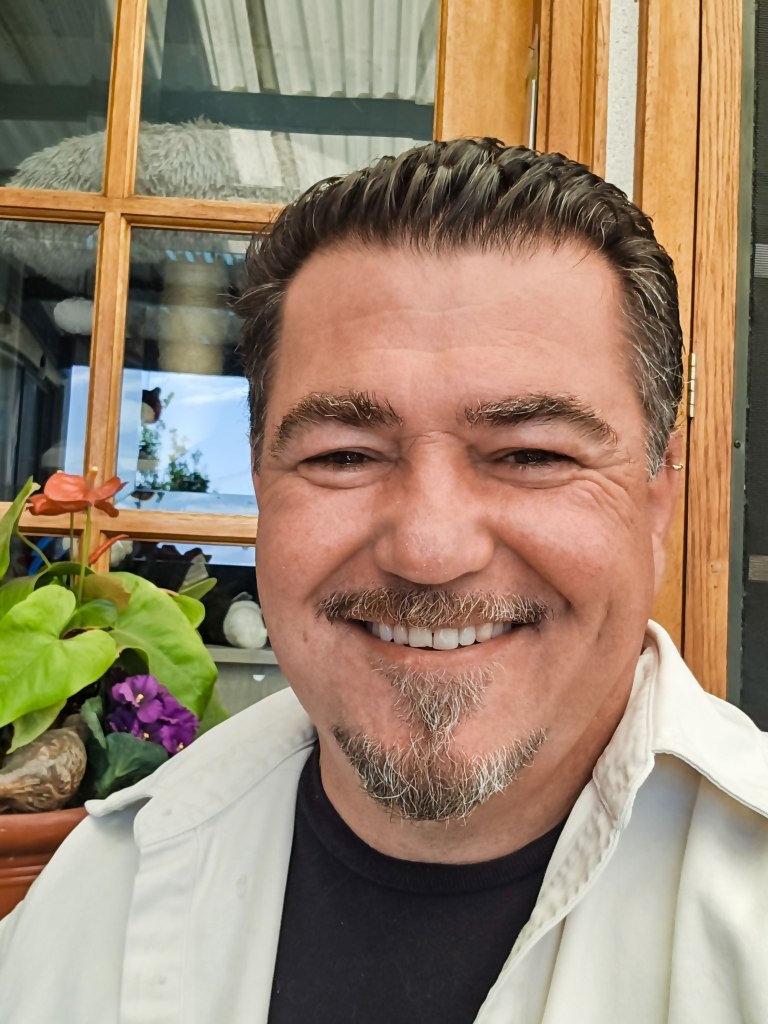
I’m an aspiring philosopher, painter, photographer, novelist, musician, and the haphazard creator of luxury furniture.
Born in Romania in the mid-seventies, I was there exposed to a wide diversity of environments during my formative years, this before moving to the US as a kid in the early 80s: from spending time with relatives in the idyllic countrysides along the Carpathian Mountains and the Danube River to partaking of the bustle in the capital. Within the capital, I mingled as a child with artists and academics, some of which were family, others whose works I was exposed to through family members. To this effect, my mother graduated from the Academy of Arts, while my father was a systems analyst, with many in my extended family partaking of academia.
As for my affinities toward art, I was about four years old when I was first greatly moved by the significant role which it can have:
There was then a large earthquake, catastrophic for many, including two very loved, close friends of the family, newlyweds, who passed away buried under a mound of bricks that had fallen from a building. The following night, I saw my mother tirelessly paint a canvas nearly as tall as herself—the canvas resting on our apartment floor with its back leaning against the wall—using both paintbrushes and her fingertips, and with tears carefully restrained within her eyes. When I woke up the next day, I saw what my mom had spent the entire night painting: the heads of two wild horses with necks and manes entwined, each brightly colored against a background of darkness, each having human eyes—a representation of my mother’s two close friends. The painting wasn’t commissioned, nor was it for sale. It was simply the expression of an idea held at heart, one entwined with vast pools of emotion. And the work was to me beautifully magnificent.
As I’ve noted, this experience left a lasting impact. Since then, I’ve thought of humanity’s general body of artistic manifestations in the same manner: Many a created artwork will express the complex concepts and states of being for which the creator either lacks the words to communicate in plain language or, otherwise, has no inclination to, but, nevertheless—either consciously or unconsciously—yet finds themselves completed to externalize. Though exceptions to this do readily occur—such as, for just one example, can be the case with artworks whose aim is strictly that of capturing something of the aesthetic—to this day, it to me remains the allegorical communication of personal truths which most immediately captivates and humanizes.
On the other hand, more in line with my father’s character, there’s the science-loving, analytical part of me. Rather than comic books, I nerdishly read Darwin, Einstein, and the likes in high school for fun, this in addition to fictional works of all kinds.
While at the University of California at Irvine, after changing my major from biology to cognitive sciences, I completed independent research projects as an undergraduate concerning the evolution of the human smile and, more broadly, of facial expressions in general. The results I obtained were excellent, with one experiment—which evidenced that the eyes are significantly more important than the mouth in humans’ nonverbal communications, much including in the human smile—having a probability of being wrong equivalent to 0.000, the maximum that was reported.
My father’s untimely death due to a sudden heart attack shortly after my graduation from UCI and the ensuing responsibilities I then had to assume, however, cut short my ambitions to formally publish these results in scientific journals and to go on to graduate school. Despite this, I’ve retained avid interests in science and philosophy, more recently doing my best to finalize the insights I’ve acquired along the way via my own, currently ongoing work of analytically metaphysical philosophy: An Enquiry into the Nature of Being.
Looking back upon my life, I can confidently affirm that it’s been a turbulent mixture of elements—some extremely positive, whereas others … well, not so much. From these, I find that I’ve gained a great range of experiences—timid though I typically am about sharing them—together with a deeper appreciation for life’s vastly differing aspects.
My explorations of both the aesthetic and analytical aspects of life, and of reality in general, stem from this, here briefly highlighted, background. The blending of creativity and enquiry is my ideal way of being, my modus operandi, so to speak: an important nourishment though which the sweetness of life can be tasted despite the sorrows and strifes—one that provides me the fuel for both my philosophical understandings as well as my otherwise more artistic expressions.
 Michael W Moiceanu